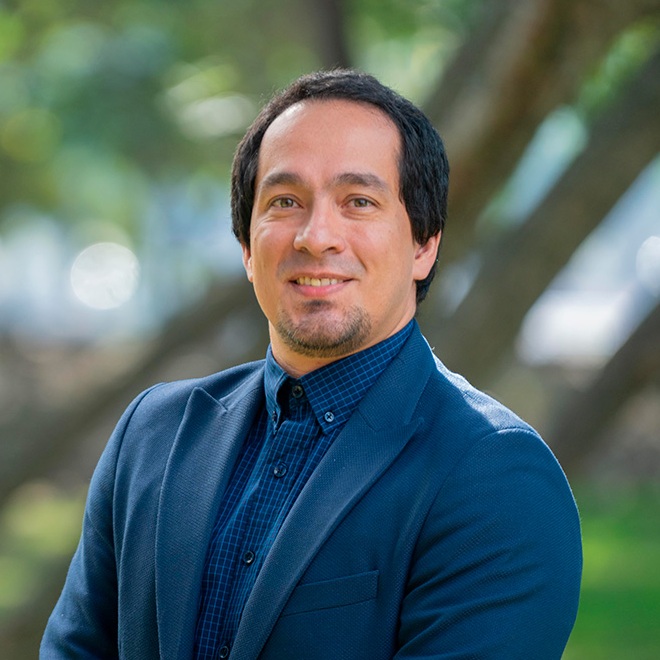
Prof. Juan Diego Sánchez-Torres
ITESO · Jesuit University of Guadalajara, Mexico
Biography
Prof. Juan Diego Sánchez-Torres has been a Full Professor at ITESO, the Jesuit University of Guadalajara, since June 2021. He teaches courses such as Convex Optimization in the Master’s in Data Science, Financial Mathematics, Monte Carlo Methods, and Quantitative Finance.
His research contributions include optimization models and predictive algorithms for energy systems and financial applications. He has supervised doctoral theses on Lyapunov-based methods for fixed-time stabilization, nonlinear discrete-time control systems, optimal design of nanostructured sensors, and optimal decision-making for corporate travel management.
He is currently supervising doctoral theses on support vector machine design for predicting key variables in the Mexican electrical sector, fault-tolerant control for chemical processes, and federated learning for prediction and decision-making in energy markets.
He has collaborated internationally with research teams in France, contributing to two dual-degree Ph.D. theses. He has also mentored eight master’s theses in control systems, optimization, financial engineering, and data science, and has published more than 100 peer-reviewed papers in high-impact journals and conferences.
Before becoming Full Professor, he served as Associate Professor at ITESO from June 2015 to May 2021, teaching stochastic processes, quantitative finance, and optimization methods, and conducting research on control algorithms with international collaborations. From January 2013 to May 2015, he served as Assistant Professor at ITESO, introducing computational techniques for stochastic modeling using R and teaching Black-Scholes equations, derivatives pricing, and stochastic calculus.
Abstract
Multi-robot systems face emerging deployment challenges. Mere convergence is not enough: warehouse fleets must coordinate within specified timeframes, and cooperative teams must regroup before faults propagate. The central question is whether agents can reach consensus rapidly enough.
Addressing this challenge enables a broad range of applications, including industrial fleets schedulable against deadlines, cooperative manipulation suitable for deployment near humans, and drones operating within defined time windows.
A suitable framework must provide robustness against bounded disturbances, performance guarantees in challenging environments, and designer-specified high-speed convergence. Sliding-mode methods provide robustness, while predefined-time theory establishes timing guarantees. Together, these approaches can satisfy key requirements for strongly connected, weight-balanced graphs with adequate state estimation.
These guarantees remain fragile under transmission delays, quantized exchanges, event-triggered communication, packet losses, and unscheduled agent loss. Determining the conditions under which predefined time bounds are preserved remains a central open challenge.
The proposed framework operates at the decision and coordination levels, while physical interaction control, motion planning, and probabilistic localization remain upstream concerns. The talk considers applications in industrial autonomous mobile robot fleets and robot-to-robot cooperative teams, and concludes with research directions in sliding modes, distributed optimization, resilient communication, learning-based perception, SE(3)/SO(3) extensions, and Industry 4.0 interoperability.