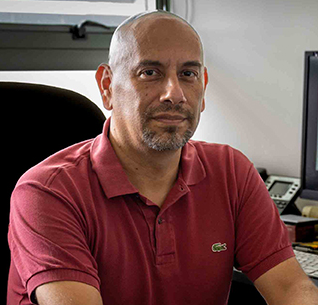
Dr. Antonio Marín Hernández
Universidad Veracruzana, Mexico
Biography
Dr. Antonio Marín Hernández holds a bachelor’s degree in Physics from Universidad Veracruzana, a master’s degree in Artificial Intelligence from the same university, obtained in 1998, and a Ph.D. from the National Polytechnic Institute of Toulouse, France, obtained in 2004.
He is a permanent researcher at the Artificial Intelligence Research Institute of Universidad Veracruzana and a member of Mexico’s National System of Researchers, Level II. His research interests include mobile and service robotics, human-robot interfaces, digital image processing, and 3D perception.
He has been a visiting researcher at several institutions, including the Laboratory for Analysis and Architecture of Systems in Toulouse, France; the Free University of Berlin, Germany; and the Institute of Systems and Robotics at the University of Coimbra, Portugal.
He is a senior member of the IEEE Robotics and Automation Society and serves on the board of the Mexican Society for Artificial Intelligence. He has published more than 100 scientific papers in international journals and conferences. He has led basic science, frontier science, and innovation projects, and has registered several patents related to artificial intelligence and perception.
He has received the Universidad Veracruzana Interdisciplinary Research Award twice, the Veracruz State Science and Technology Award in 2020, and, recently, in 2025, was appointed Dean of Universidad Veracruzana.
Abstract
This talk will analyze the critical role of Human-in-the-Loop integration within the fields of service and collaborative robotics.
As robots transition from isolated industrial environments to dynamic, human-centered spaces, such as offices, hospitals, homes, and shared manufacturing facilities, seamless human-robot interaction becomes essential.
In this field, factors such as human confidence and productivity are central. Concepts such as attention, intention, and proximity are required to improve task efficiency and error recovery, as well as to enable safe robotic implementations around users.
The talk will present advances in human-robot interaction developed by the intelligent robotics group of the Artificial Intelligence Research Institute at Universidad Veracruzana and its collaborators, particularly in autonomous robot navigation, human collaboration, and collaborative industrial spaces.