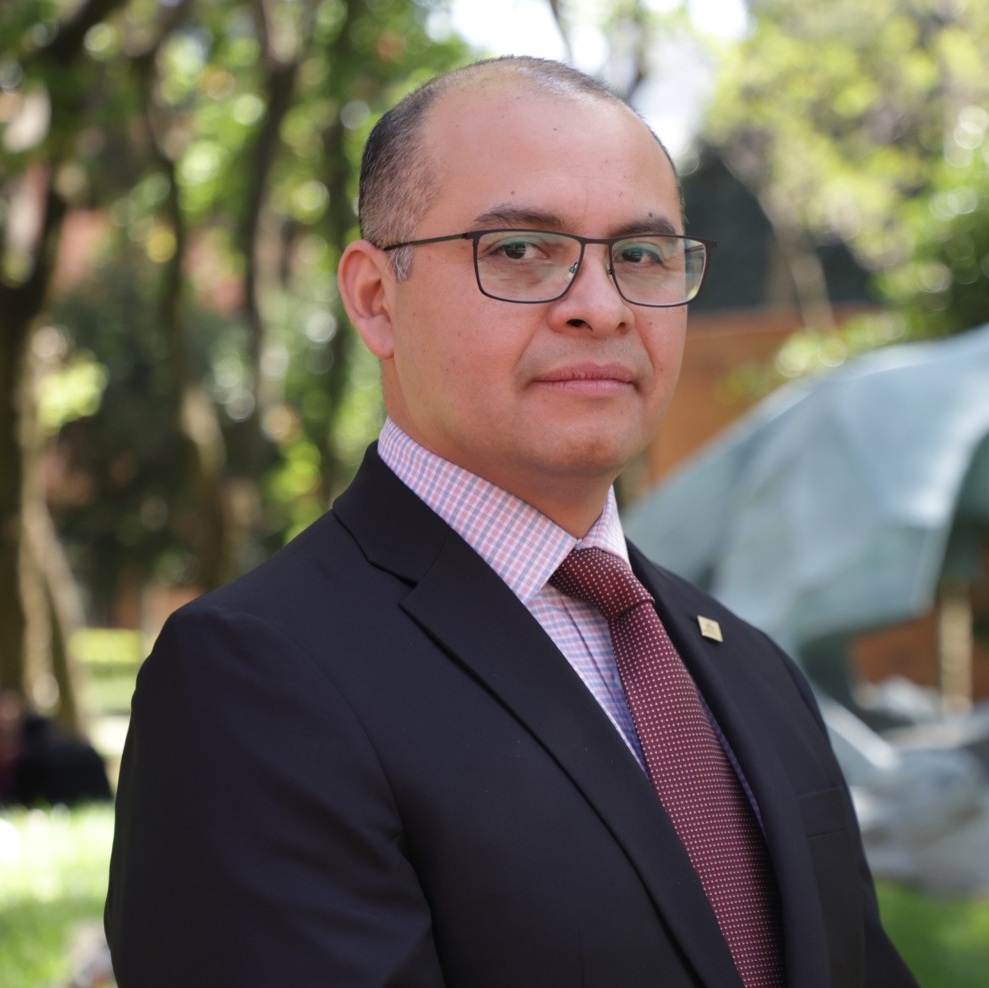
Prof. Eduardo Gamaliel Hernández-Martínez
Universidad Iberoamericana Ciudad de México, Mexico
Biography
Prof. Eduardo Gamaliel Hernández-Martínez holds a degree in Electrical Engineering with a specialization in Industrial Instrumentation from the Instituto Tecnológico de Orizaba, Veracruz, and master’s and doctoral degrees in Electrical Engineering with a specialization in Mechatronics from CINVESTAV of the Instituto Politécnico Nacional.
He has been a member of the Sistema Nacional de Investigadores since 2011 and is currently Level I. He has professional experience in electrical and instrumentation projects, as well as industrial maintenance.
From 2007 to 2011, he served as professor, researcher, and coordinator of the Master’s Program in Industrial Engineering at the Instituto Tecnológico de Estudios Superiores de Coacalco.
Since 2011, he has been a full-time professor at Universidad Iberoamericana Ciudad de México, where he served as head of the Electronics Engineering laboratories and coordinator of the master’s and doctoral programs in Engineering Sciences.
In 2023, he assumed the position of Director of the Division of Science, Art and Technology (DiCAT). Since 2018, he has directed the Institute for Applied Research and Technology (InIAT) at IBERO Mexico City, where he promotes interdisciplinary research projects in health technologies, automation, sustainability, and informatics.
His research focuses on modeling, control, and simulation of dynamical systems, particularly multi-agent systems. He has been a member of the Mexican Association of Automatic Control, IEEE, and the International Society of Automation.
He has published approximately 50 papers in JCR-indexed journals, several book chapters, and full papers in national and international conferences on robotics, control systems, and automation. He has supervised doctoral theses, master’s theses, and undergraduate projects in mechatronics engineering. He has taught courses in control engineering, robotics, advanced control, multi-agent robotics, and discrete-event systems. He has developed technologies for mobile robots and drones for industrial, educational, and service applications.
Abstract
The study of motion coordination in groups of mobile robots has grown in recent years, with multiple applications in industry and services.
Fundamental collective behaviors such as formation, motion in formation, and collision avoidance have been extended to practical uses such as cooperative object transport, sensor networks, perimeter surveillance, and related applications.
Each application requires modeling interactions among mobile agents in terms of relative positions, distances, alignment angles, leader-follower relationships, and other variables, bringing implementation challenges in sensing and control laws.
This talk provides an overview of theoretical and practical experiences over 20 years of collaboration with several institutions in Mexico and abroad. It also presents reflections on the future of these technologies and the opportunities they bring to the research community.