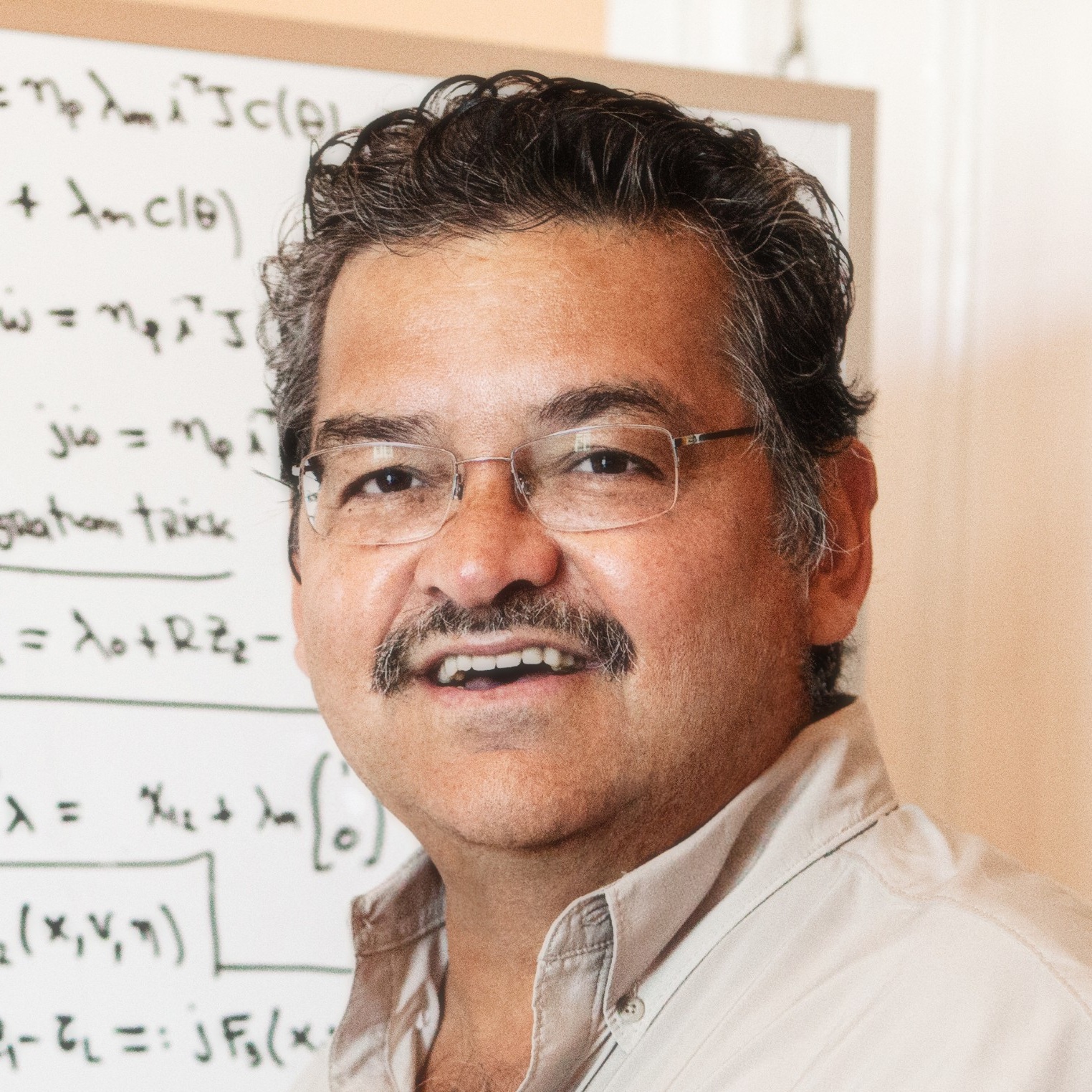
Prof. Romeo Ortega
ITAM, Mexico · ITMO University, Russia
Biography
Prof. Romeo Ortega was born in Mexico. He obtained his B.Sc. in Electrical and Mechanical Engineering from the National University of Mexico, his Master of Engineering from the Polytechnical Institute of Leningrad, USSR, and the Docteur D’État from the Polytechnical Institute of Grenoble, France, in 1974, 1978, and 1984, respectively.
He then joined the National University of Mexico, where he worked until 1989. He was a Visiting Professor at the University of Illinois in 1987–1988 and at McGill University in 1991–1992, and a Fellow of the Japan Society for the Promotion of Science in 1990–1991.
He was a member of the French National Research Council (CNRS) from June 1992 to July 2020, where he was a Directeur de Recherche in the Laboratoire de Signaux et Systèmes (CentraleSupélec) in Gif-sur-Yvette, France.
He is currently a full-time Professor at ITAM in Mexico and a Distinguished Professor at ITMO University in Russia. His research interests are in nonlinear and adaptive control, with special emphasis on applications.
Dr. Ortega has published five books and more than 405 scientific papers in international journals, with an h-index of 102. He has supervised more than 35 Ph.D. theses. He is the recipient of the Automatica Best Paper Award (2014–2016) and the IFAC High Impact Paper Award 2026.
He has been an IEEE Fellow since 1999, IEEE Life Fellow since 2020, and IFAC Fellow since 2016. He has served as chair in several IFAC and IEEE committees and participated in editorial boards of international journals. He is currently Editor-in-Chief of the International Journal of Adaptive Control and Signal Processing and Senior Editor of the Asian Journal of Control.
Abstract
This talk addresses the problem of adaptive velocity observation in a simple mechanical system with unknown friction forces, modeled with classical Coulomb plus stiction components.
An analytical and experimental comparison is carried out between two designs based on sliding mode control (SMC) and immersion and invariance (I&I) techniques.
After a brief introduction to both techniques, experimental results are presented, showing the well-known lack of robustness of the SMC design and the excellent performance of the I&I design.
The talk concludes with reflections on the pertinence of using SMC in application tasks, particularly in mechanical systems.